
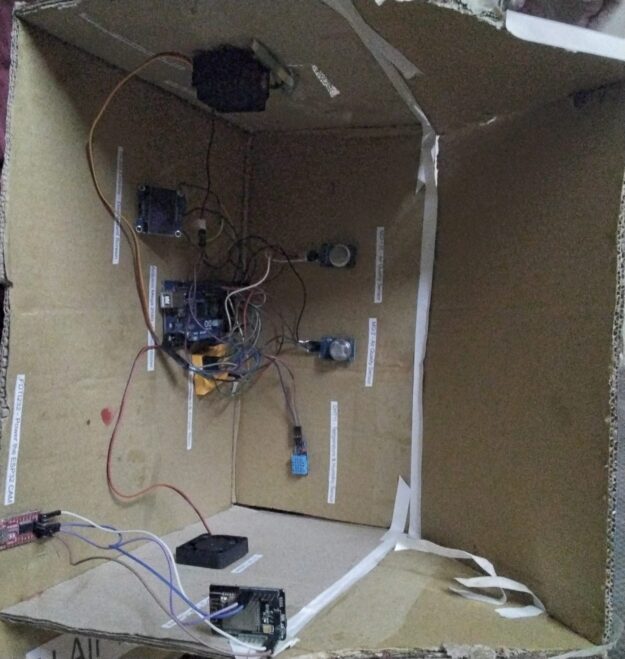


AI Air Vent Systen
Original price was: ₹2,000.00.₹1,900.00Current price is: ₹1,900.00.
Weight (kg): 1.2
The AI Air Vent System — an automated air-quality monitoring and ventilation solution designed for homes, schools, factories, and labs. Using smart gas sensors, temperature tracking, servo-based vents, and real-time monitoring, it detects harmful gases and improves indoor air quality instantly. Built to protect health, prevent accidents, and make environments smarter, safer, and energy-efficient.
Description
Objective
The main objective of the AI Air Vent System is to automatically monitor and improve air quality by using smart sensors and automation technology.
It aims to detect harmful gases, smoke, temperature, and humidity levels, and control ventilation through fans and vents without human effort.
The project focuses on creating a safe, energy-efficient, and environment-friendly system suitable for homes, schools, and industries.
Components Used:
- Arduino Mega 2560
- OLED – SSH1106 (Organic Light Emitting Diode)
- MQ-2 (Air Quality Sensor)
- MQ-135 (Air Quality Sensor)
- DHT11 (Temperature & Humidity Sensor)
- Breadboard
- Fan – 12V (2)
- Servo Motors (2)
- ESP32 CAM
- FDTI232
How the AI Air Vent System Works
The system continuously collects data from three sensors:
→ MQ-2 → detects smoke, LPG, and flammable gases. → MQ-135 → detects toxic gases and pollutants like CO₂, ammonia, and benzene. → DHT11 → measures temperature and humidity.
All sensor values are sent to the Arduino Mega, which acts as the brain of the system.
The Arduino checks if gas levels are above the safe threshold.
If the sensors detect toxic or dangerous gases, the system decides:
“Air quality is bad → Open the windows. Turns fans ON to push out polluted air.”
If the air is safe:
“Air quality is good → Keep the windows closed. Turns fans OFF”
Based on the decision, the servo motors rotate to either:
→ Open the windows/vents when air quality is poor.
→ Close them back when the environment is safe again.
→ Turn the fans ON/OFF depending upon the air quality.
The OLED screen acts as the dashboard of the system.
- It shows live readings:
→ Temperature, Humidity, Gas sensor values - If gases are detected, the OLED also shows a warning message
Properties & Uses of the Components used
- Arduino Mega 2560
→ Microcontroller board with 54 digital I/O pins, 16 analog inputs, 4 UARTs, and plenty of memory.
→ Works at 5V.
→ Acts as the brain of the system.
→ Reads data from sensors, processes it, and controls the servos + OLED display.
→ Reliable for handling multiple sensors at once because of the many pins.
- OLED – SSH1106 (Organic Light Emitting Diode)
→ Resolution: 132 × 64 pixels (slightly wider than SSD1306’s 128 × 64).
→ Technology: OLED (Organic Light Emitting Diode) – every pixel lights up individually (no backlight needed).
→ Interface: Usually I²C (2 pins: SDA + SCL), sometimes SPI.
→ Power: Works at 3.3V or 5V, very low power consumption.
→ Brightness & Contrast: Clear, high-contrast display, even in dark environments.
→ Size: Typically 0.96″ or 1.3″ small screen, compact, and lightweight
- MQ-2 (Air Quality Sensor)
→ Sensitive to flammable gases, propane, alcohol, smoke, LPG, methane, hydrogen, and carbon monoxide.
→ Has analog output (gas level) and digital output (threshold detection).
→ Detects smoke and flammable gases in the environment.
→ Alerts system to open windows when gas levels are unsafe.
- MQ-135 (Air Quality Sensor)
→ Sensitive to air pollutants such as ammonia, NOx, alcohol, benzene, smoke, CO₂, sulphur compounds.
→ Analog + digital outputs.
→ Detects toxic and harmful gases that affect indoor air quality.
→ Helps identify when the air is not healthy.
- DHT11 (Temperature & Humidity Sensor)
→ Measures temperature (0–50°C) and humidity (20–90%).
→ Digital output, simple to use.
→ Provides comfort-related data.
→ Ensures the system not only checks safety (gas) but also comfort (temp & humidity).
- Servo Motors (2)
→ Small motors with precise angle control (0° to 180°).
→ Powered by PWM (Pulse Width Modulation) signals.
→ Act as automatic window openers.
→ When gas is detected, they rotate to open the vent or window, and close it when air is safe.
- Fans – 12V (2)
→ The fans help remove polluted or hot air when gases are detected.
→ Replaces it with fresh, clean air through the vents opened by servo motors.
- ESP32 CAM
→ Acts as the IoT controller for the system.
→ Connects to Wi-Fi to enable IoT functionality.
→ Streams live camera feed for visual monitoring of the environment.
- FDTI232
→ Used to program and communicate with microcontrollers like the ESP32-CAM
→ Converts USB signals from a computer into serial (TTL) signals the microcontroller can read.
Advantages
- No need for humans to keep checking air freshness – the system detects harmful gases (MQ-2, MQ-135) and opens the windows automatically.
- Prevents headaches, nausea, and long-term health risks caused by toxic gases like CO₂, smoke, or LPG leaks.
- Alerts immediately when air quality drops.
- Windows only open when needed, reducing energy wastage (like fans/ACs running unnecessarily).
- It can later be connected to the ESP32 camera for real-time monitoring.
- It can be upgraded with mobile app alerts or even integrated into smart homes.
- Low-cost (sensors like MQ-2, MQ-135, DHT11 are affordable).
- Customizable – you can adjust thresholds for schools, homes, labs, or hospitals.
- Failsafe system – Even if one sensor fails, another one can still detect air quality.
- User-friendly – OLED display makes it easy to read data instantly.
- Eco-friendly – Uses natural ventilation (opening windows) before relying on machines.
- Smart Windows that Think – They “decide” based on air quality.
- Future-ready – With ESP32 camera integration, it can become a full AI-based indoor air monitoring & security system.
- Safety + Comfort in One – Protects health and makes the environment more comfortable at the same time.
Applications of the AI Air Vent System
- Factories and Industrial Areas
→ Used in manufacturing units, where fumes or smoke are produced.
→ The system can automatically ventilate areas to prevent suffocation or fire risks.
- Fire and Safety Systems
→ Acts as an early warning system — detects smoke or gas leaks quickly.
→ Opens vents and starts fans automatically to reduce fire or explosion risk.
- Laboratories and Chemical Rooms
→ Detects toxic gases or smoke from experiments.
→ Automatically opens vents and turns on fans for quick air purification.
- Parking Garages and Workshops
→ Detects carbon monoxide and other harmful gases from vehicles.
→ Activates ventilation automatically to keep workers safe.
- Worker Safety and Health
→ In factories, workshops, and warehouses, workers are often exposed to harmful gases, dust, or fumes.
→ The AI Air Vent System can detect toxic gases like carbon monoxide, ammonia, or smoke and immediately ventilate the area.
→ This helps protect workers’ health, prevent dizziness or suffocation, and ensures a safe working environment.
Additional information
| Weight | 1.2 kg |
|---|---|
| Dimensions | 50 × 40 × 4.99 cm |
Related products
-

-
Sale!
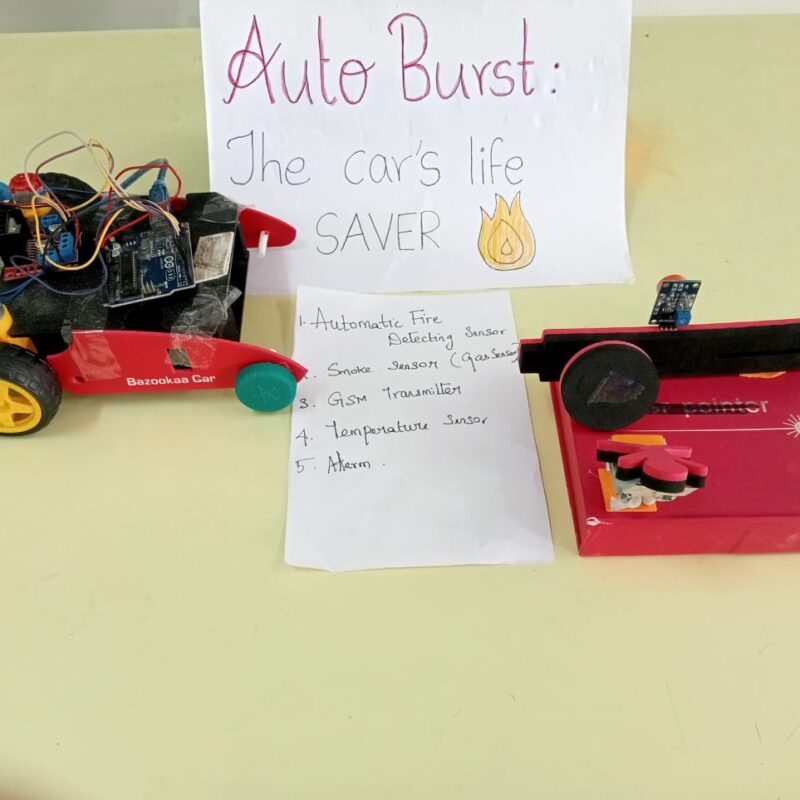
Auto Burst: The Car’s Life Saver
Original price was: ₹2,000.00.₹1,940.00Current price is: ₹1,940.00. -
Sale!
-
Sale!
 ECOMOJI PAINTS